
Syndetics is here to help libraries affected by the Baker & Taylor shutdown,
learn more.
By Tim Spalding in Deep Dives
March 23, 2026
On Friday, Project Hail Mary opened in theaters to rave reviews and an impressive $80m in domestic box-office. If you're a librarian, you saw it coming—a flood of patrons eager to read Andy Weir's original 2021 novel before the movie adaptation came out. It may have seemed like the book was as popular—or more popular!—than ever. And you're expecting that to continue, as interested movie-goers head to the library to get the complete story.
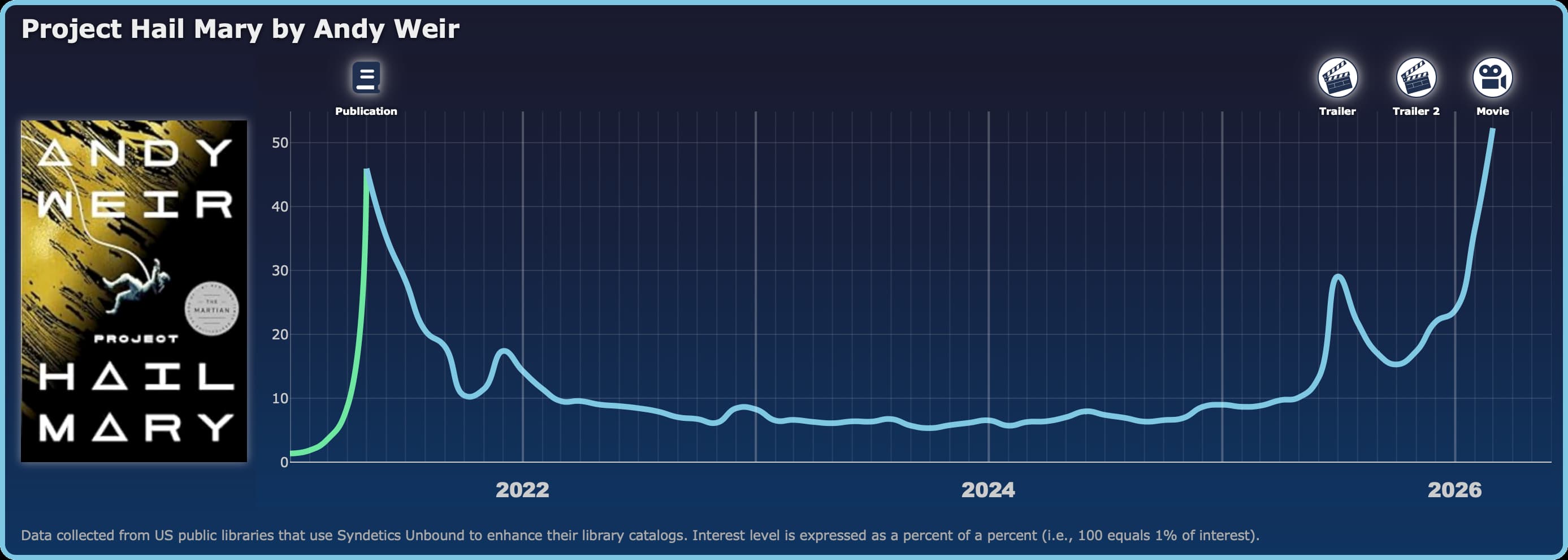
Syndetics Unbound can put numbers to what you saw. We've been tracking catalog interest in Project Hail Mary across thousands of US public libraries since it was published in May 2021. As you can see from the chart, the novel attracted pre-release interest (i.e., holds), on the strength of Weir's 2011 novel The Martian, adapted into a movie in 2015. Interest peaked in May then gradually declined, until the first movie trailer dropped in June 2025, sending interest climbing. A second trailer in November 2025 kept the momentum going. A Super Bowl spot on February 8 likely contributed. And now, with the film in theaters, the book is attracting more interest than it's ever had.
But Project Hail Mary is just the latest example. Using Syndetics Unbound data, we tracked the interest trajectories of more than 50 books that have been adapted for film and television, presenting 18 here. The data show how adaptations affect library demand, and offer useful lessons for collection development, displays, and patron engagement.
For Data Heads: How does Syndetics Unbound know patron interest and what do the numbers mean? In short, we measure the titles library patrons search for and visit. The search data is fully anonymized the day it is collected. For more information, see the For Data Heads section at the end of this post.
Click any chart to see it full-size.
The clearest pattern is the most consistent: When a book gets adapted into a major film or series, library patron interest spikes.
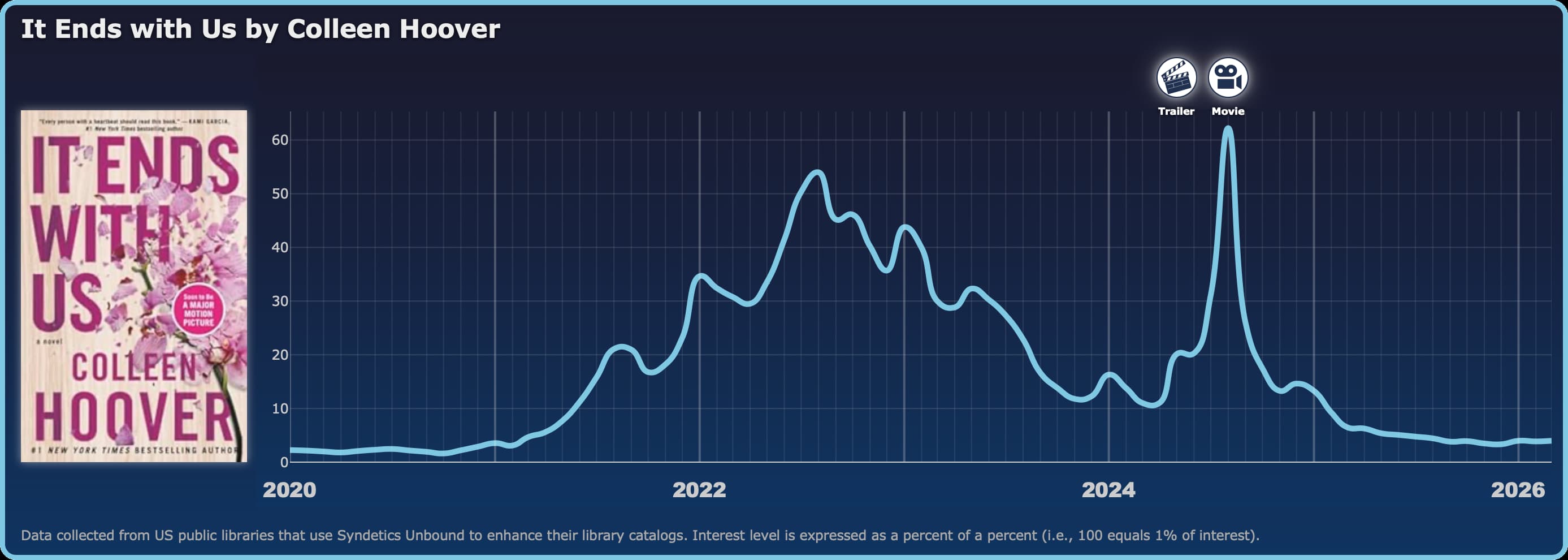
It Ends with Us by Colleen Hoover is a perfect test case. A hit back in 2016, "BookTok" rediscovered the book in 2021–2022, giving it interest numbers normally only seen in new releases. This interest had declined by early 2024, but a May trailer and August release of a movie version, starring Blake Lively and Justin Baldoni, produced a spike that exceeded the BookTok peak. The lesson? Even for books that social media has already made famous, a Hollywood adaptation finds a new audience.
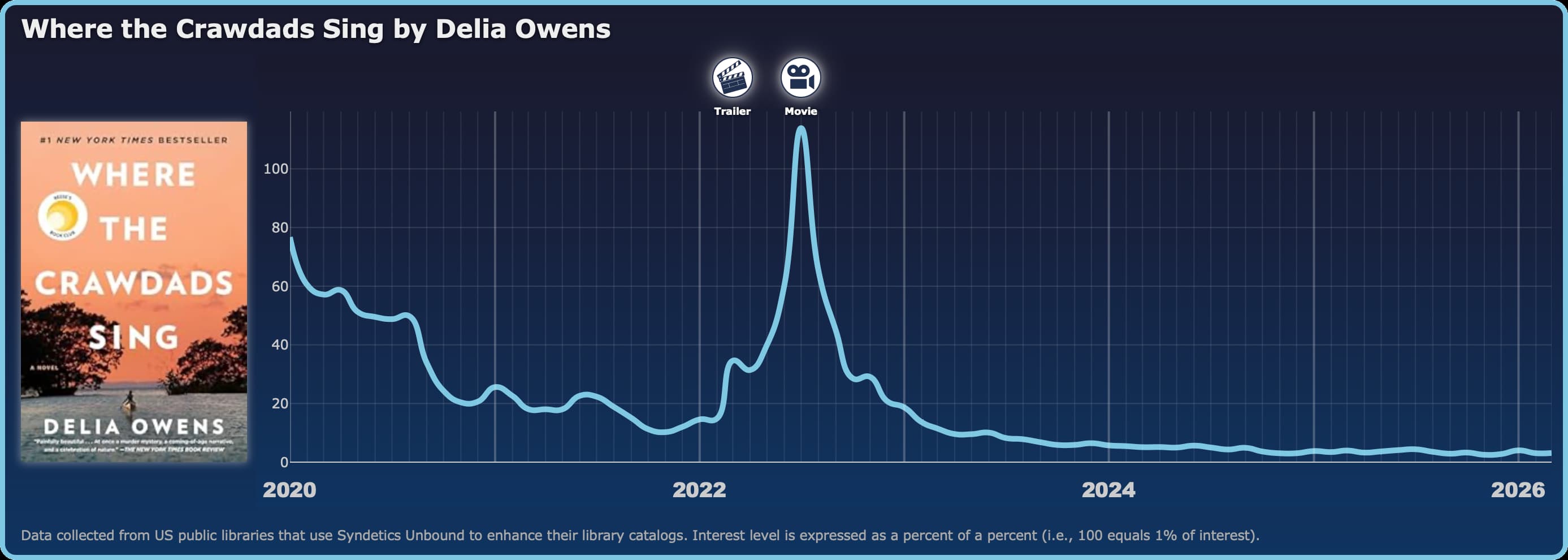
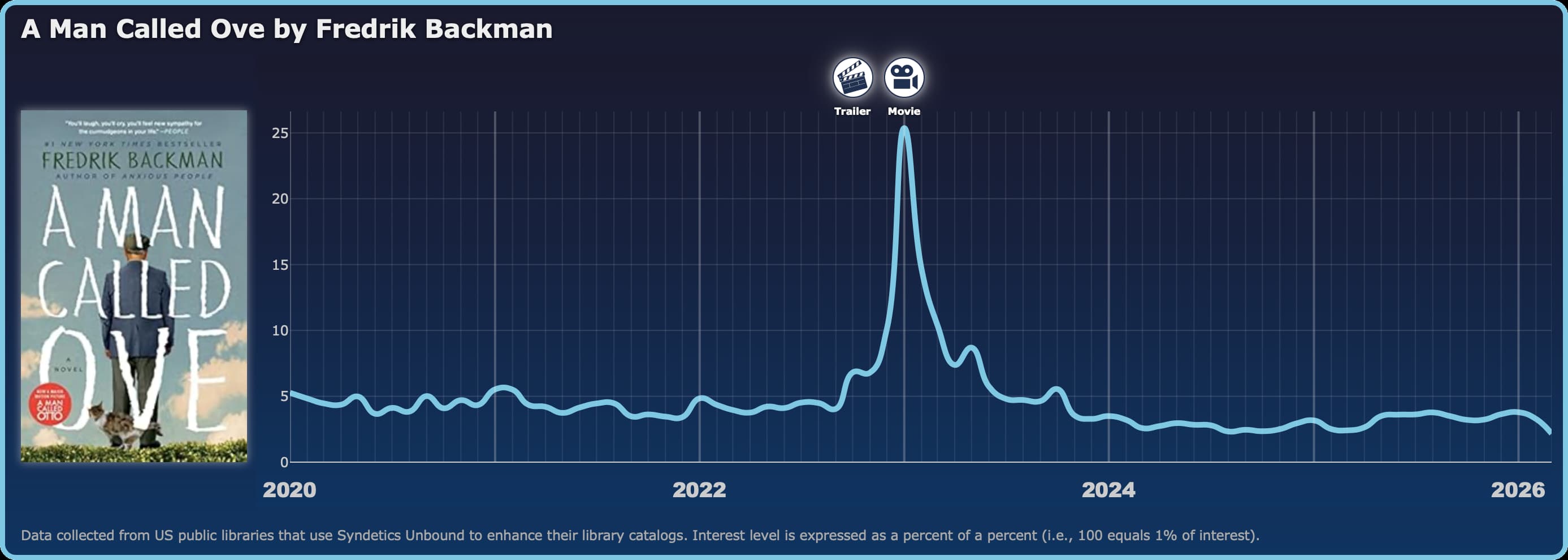
The same pattern repeats: Where the Crawdads Sing spiked with its 2022 film, A Man Called Ove got a second life from the 2022 Tom Hanks remake, Daisy Jones & The Six surged with its 2023 Amazon series, and Killers of the Flower Moon went from near-zero to peak interest when Scorsese's film hit theaters in October 2023.
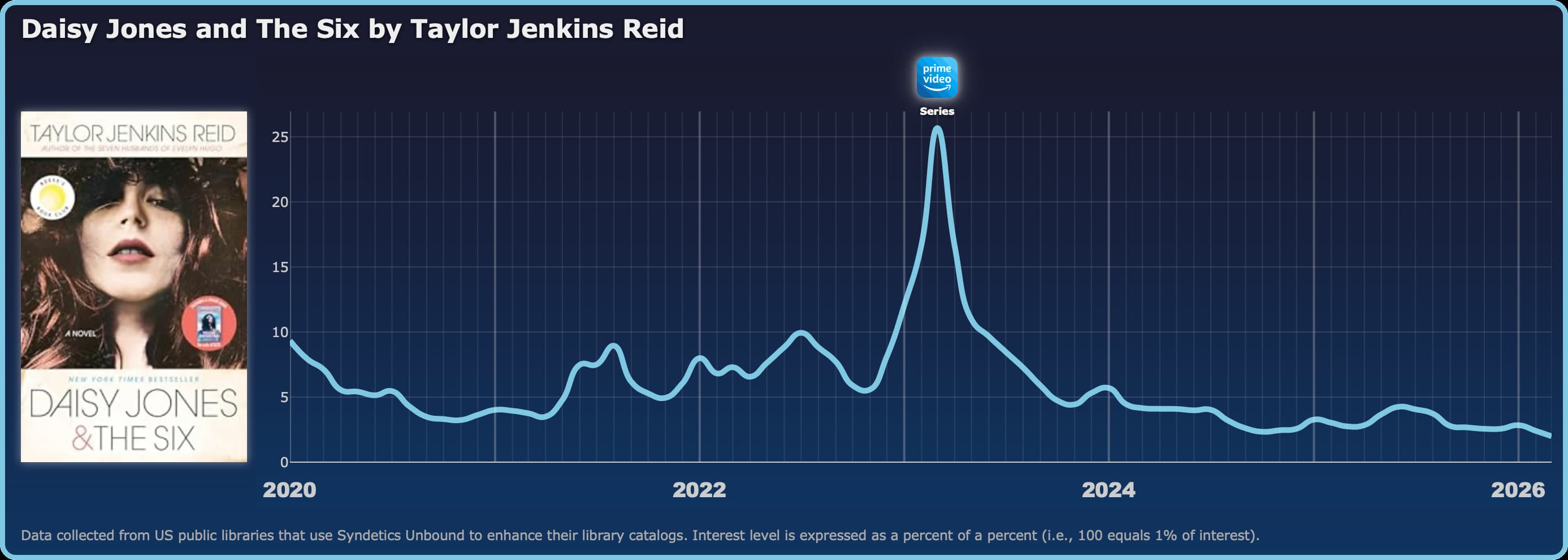
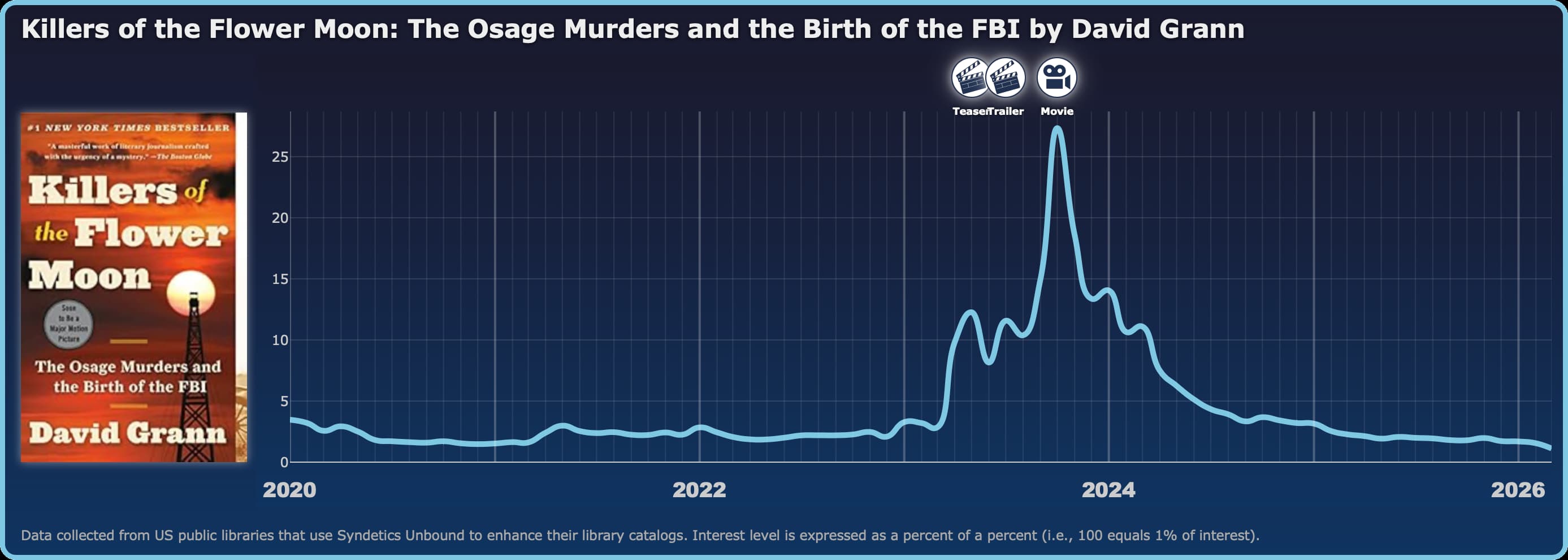
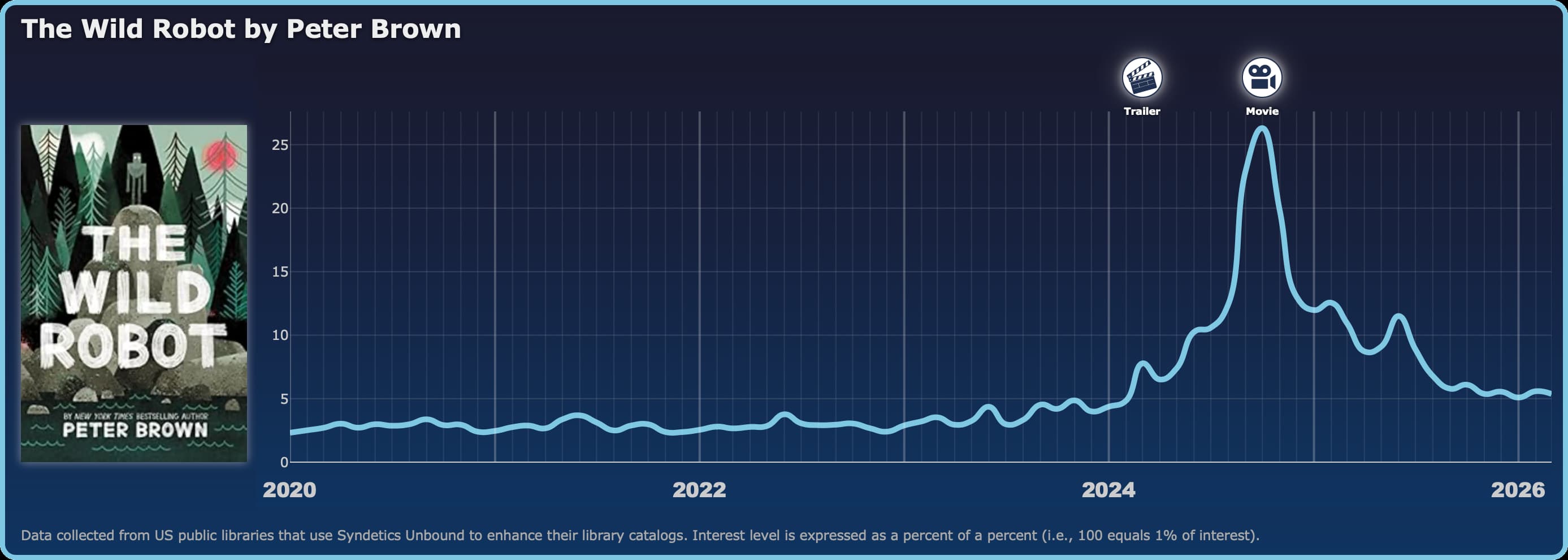
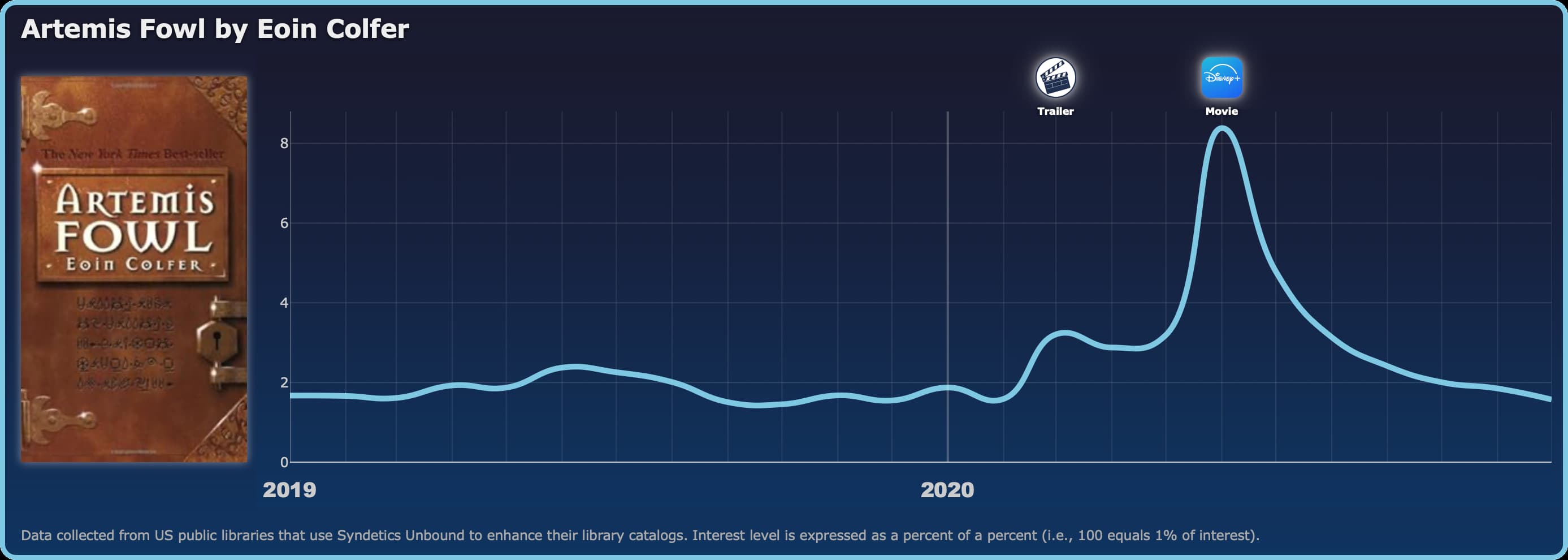
You see the same for children's books. The Wild Robot by Peter Brown spiked with its 2024 DreamWorks film, and Artemis Fowl by Eoin Colfer got a bump from Disney's 2020 adaptation:
While movies produce a single sharp spike, TV series adaptations can create something more interesting—recurring waves of interest that keep a book circulating for years.
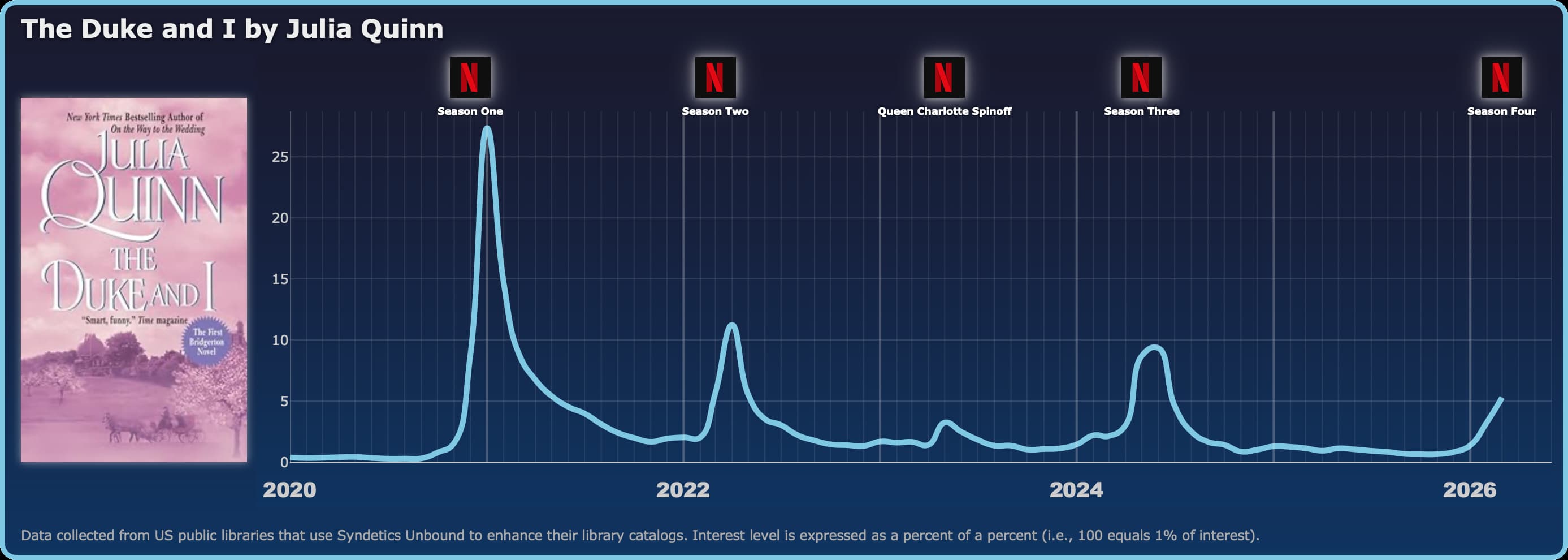
Bridgerton, based on Julia Quinn's The Duke and I, is the clearest example. Four Netflix seasons have produced four separate, clearly visible spikes. The first season created a massive surge and every subsequent season has revived interest. A shorter spin-off series, Queen Charlotte: A Bridgerton Story produced a smaller bump in between seasons two and three. Not being a Bridgerton fan, we originally thought the May bump was noisy data, but—sure enough—we found the spin-off where the bump was!
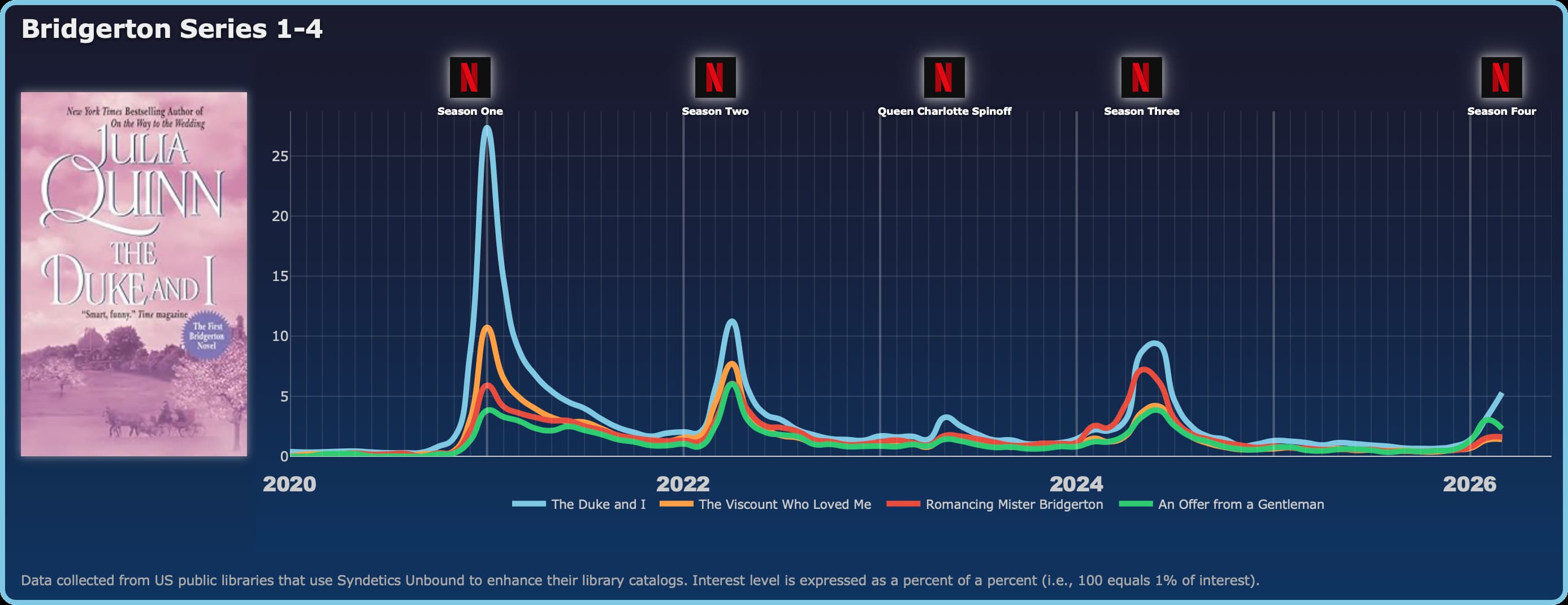
Bridgerton also shows how adaptations can grow patron interest past the first book in a series. Here's the same chart, with lines for the first four Bridgerton books. Season one adapted The Duke and I, season two The Viscount Who Loved Me, season three Romancing Mister Bridgerton, and season four An Offer from a Gentleman.[1] In each case, the first novel, The Duke and I, spiked the highest, but the second-highest spike was the novel being adapted that TV season.
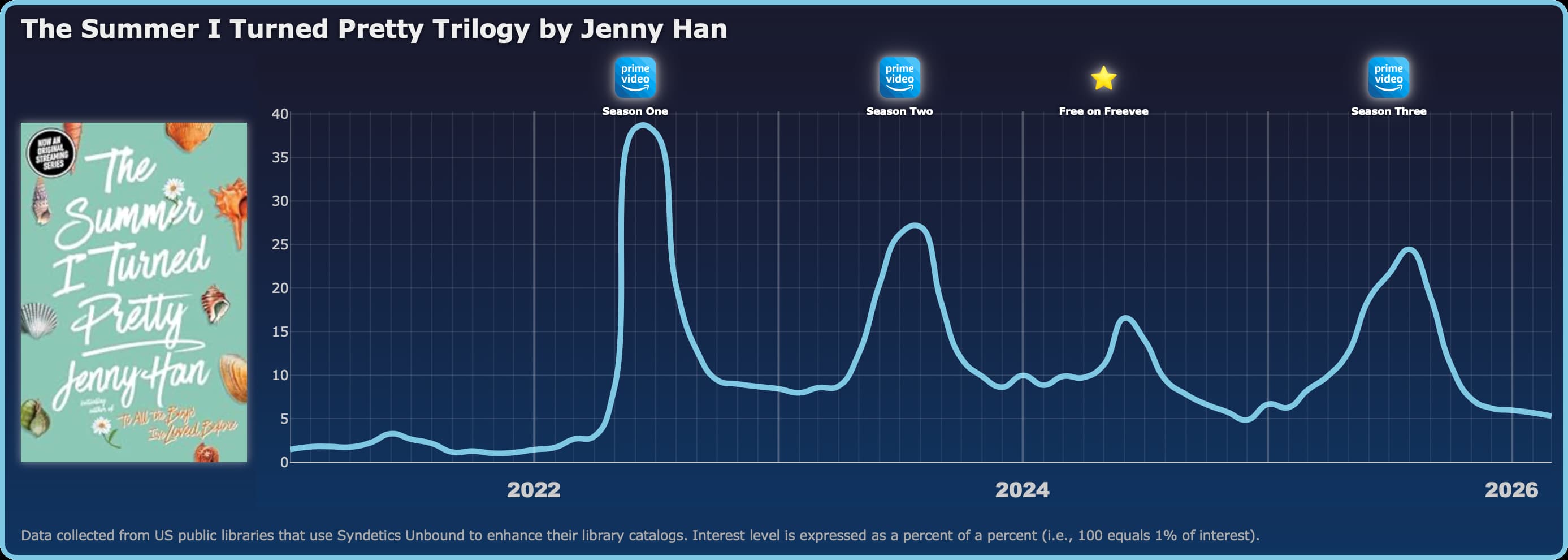
The Summer I Turned Pretty by Jenny Han shows a similar pattern. Each Amazon Prime season produced a distinct peak of library interest: June 2022, July 2023, and July 2025. A mid-2024 spike is explained by Amazon making the series available for free on Freevee on May 26, 2024. As with Bridgerton, the adaptations of The Summer I Turned Pretty heralded a sustained rise in interest for the books.
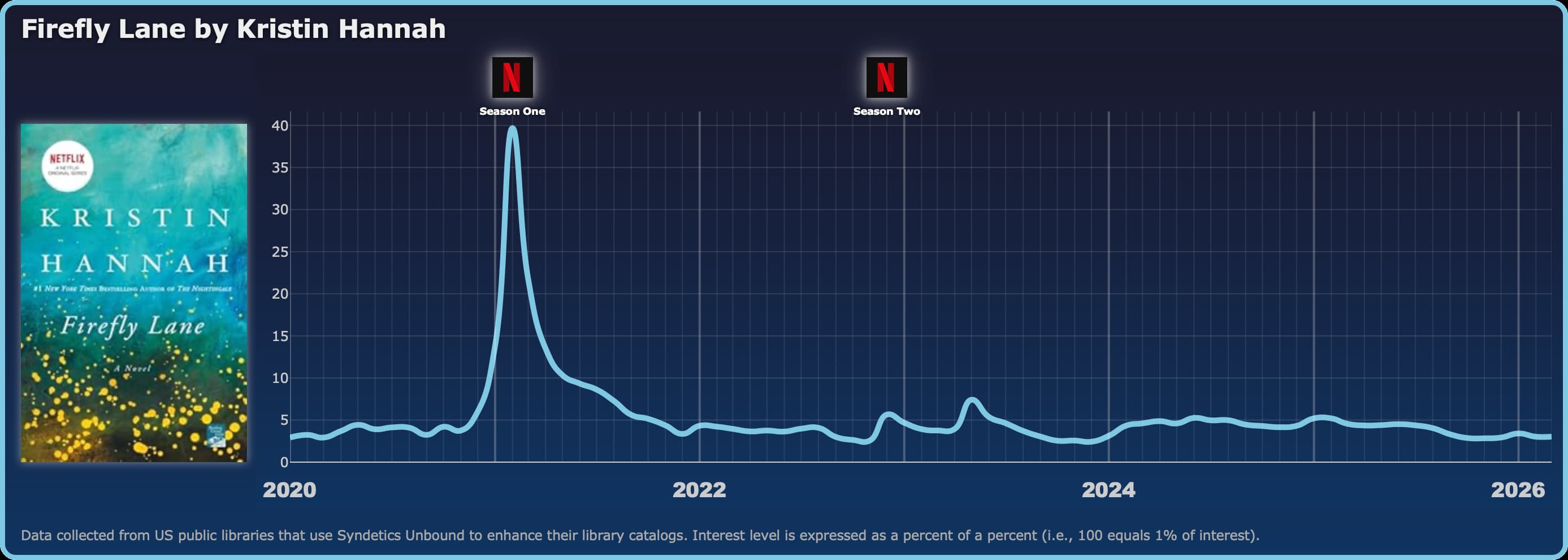
As we saw with Bridgerton and The Summer I Turned Pretty, later seasons tend to produce smaller bumps. But sometimes the drop-off is dramatic. Firefly Lane by Kristin Hannah and The Last Thing He Told Me by Laura Dave both had strong Season One spikes followed by much weaker second seasons. It wasn't that the shows lost their audiences—Firefly Lane Season Two pulled 133 million hours over five weeks on Netflix's global Top 10, and The Last Thing He Told Me became Apple TV+'s most-watched limited series ever.
One possible explanation: Both later seasons diverged significantly from their source material; when a show stops following the book, viewers have less reason to seek out the original.
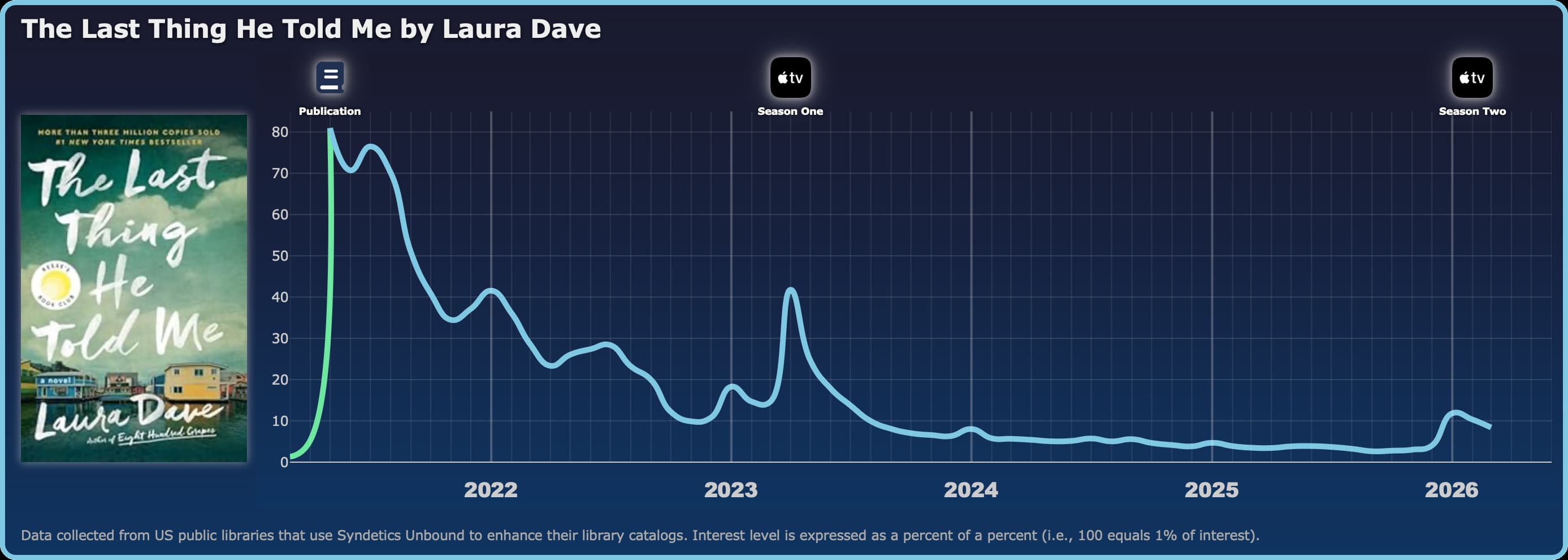
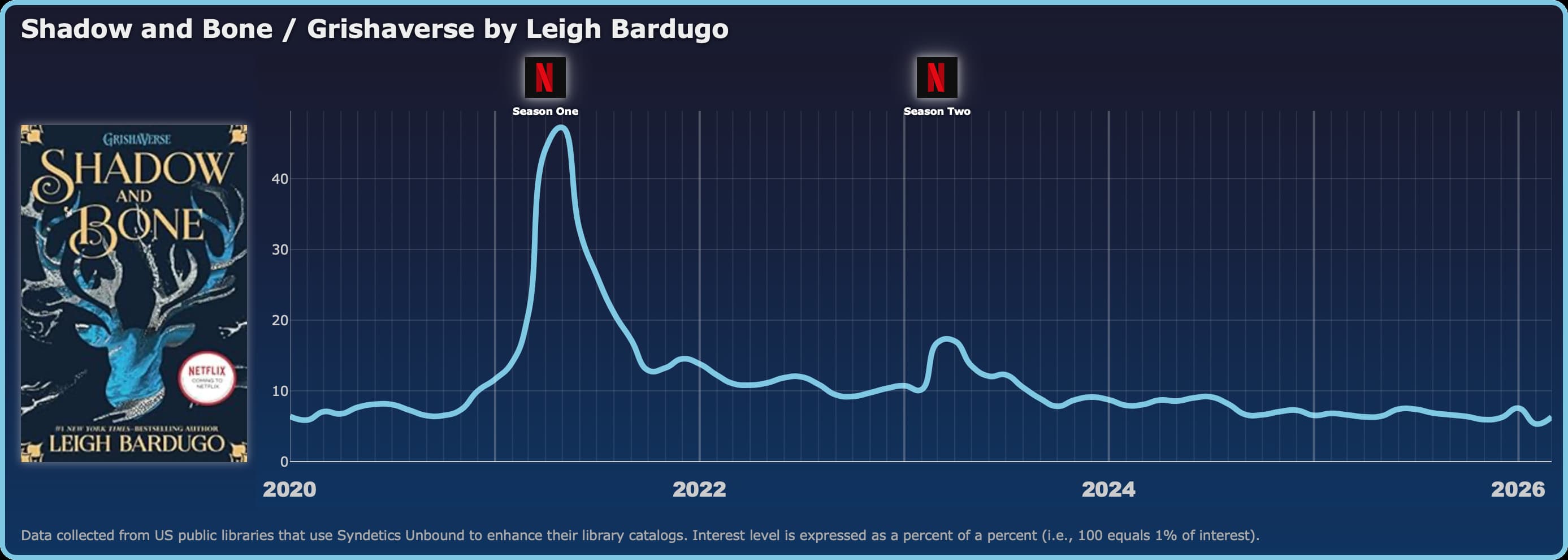
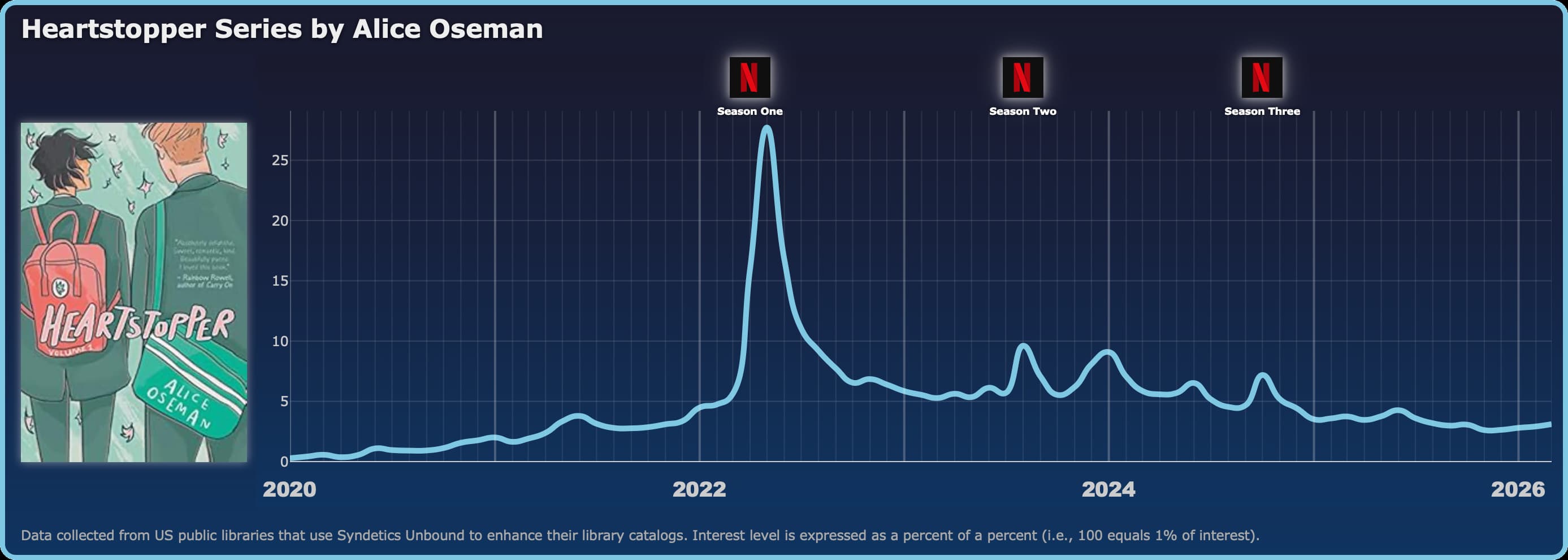
But that can't be the whole story. Shadow and Bone by Leigh Bardugo and Heartstopper by Alice Oseman show a similar drop-off, yet both shows remained faithful to their source material. Interest across the entire Grishaverse catalogue rose steadily around Netflix's Season One in April 2021, but Season Two in March 2023 produced only a small bump. Heartstopper saw a huge spike for Season One, yet Seasons Two and Three barely registered—even though Season Two actually drew slightly more viewers than Season One, roughly 55 million hours versus 53 million.
The simplest explanation is that Season One already converted most of the potential readers. The show's audience kept watching, but the people who were going to pick up the book had already done so.
The lesson for libraries? The biggest collection development opportunity comes with Season One. That's when the adaptation introduces the source material to an entirely new audience. Later seasons may still bring some readers back, if the books retain substantial interest for viewers, but the first season is the main event. Plan your copies, displays, and book club tie-ins accordingly.
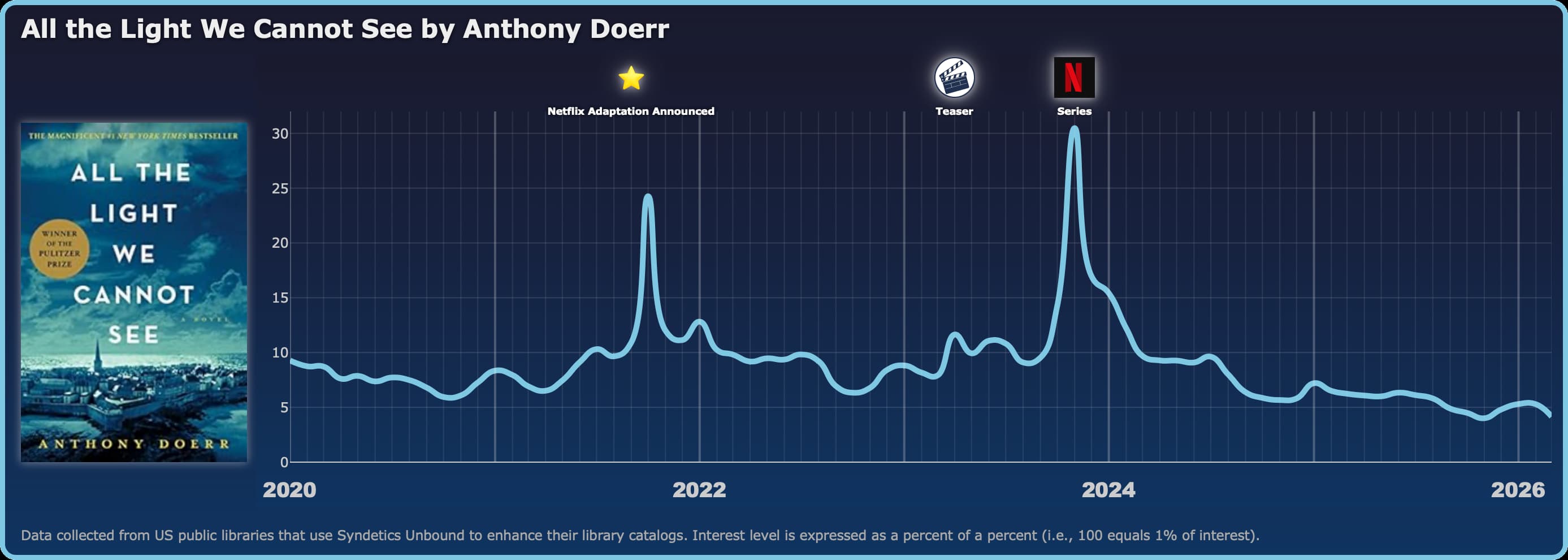
One of the most interesting findings is that interest doesn't start with the premiere. Announcements, teasers and trailers produce a measurable uptick in library interest, often weeks or months before the actual premiere.
All the Light We Cannot See by Anthony Doerr shows the stages. Published in 2014 and a Pulitzer winner, the novel had settled to a modest baseline by 2021. Then Netflix announced the adaptation in September 2021, and interest visibly jumped. The teaser in April 2023 produced another bump. The full trailer in October 2023 (not shown) pushed it higher. And when the series premiered in November 2023, interest hit its highest point in years. Three distinct pre-release events, each one building momentum.
The Ballad of Songbirds and Snakes by Suzanne Collins shows the full lifecycle beautifully: a publication spike, then a teaser in June 2022 that put the adaptation on readers' radar, a full trailer bump, a theatrical release spike, and a further bump when the film arrived on Starz for streaming. Finally, in March 2025, the publication of the next Hunger Games novel, Sunrise on the Reaping, sent interest surging all over again—proof that a franchise's momentum can reignite the backlist as well as the new title.
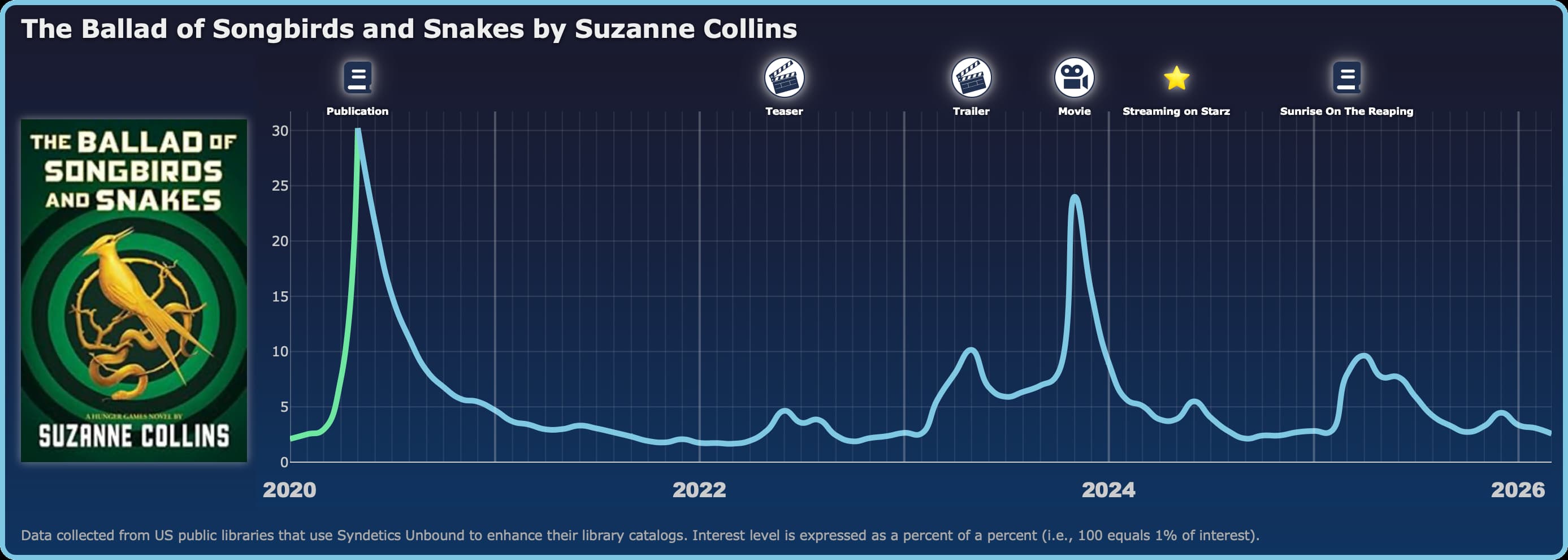
The message for librarians: when you see an adaptation announcement, that's your cue to act.
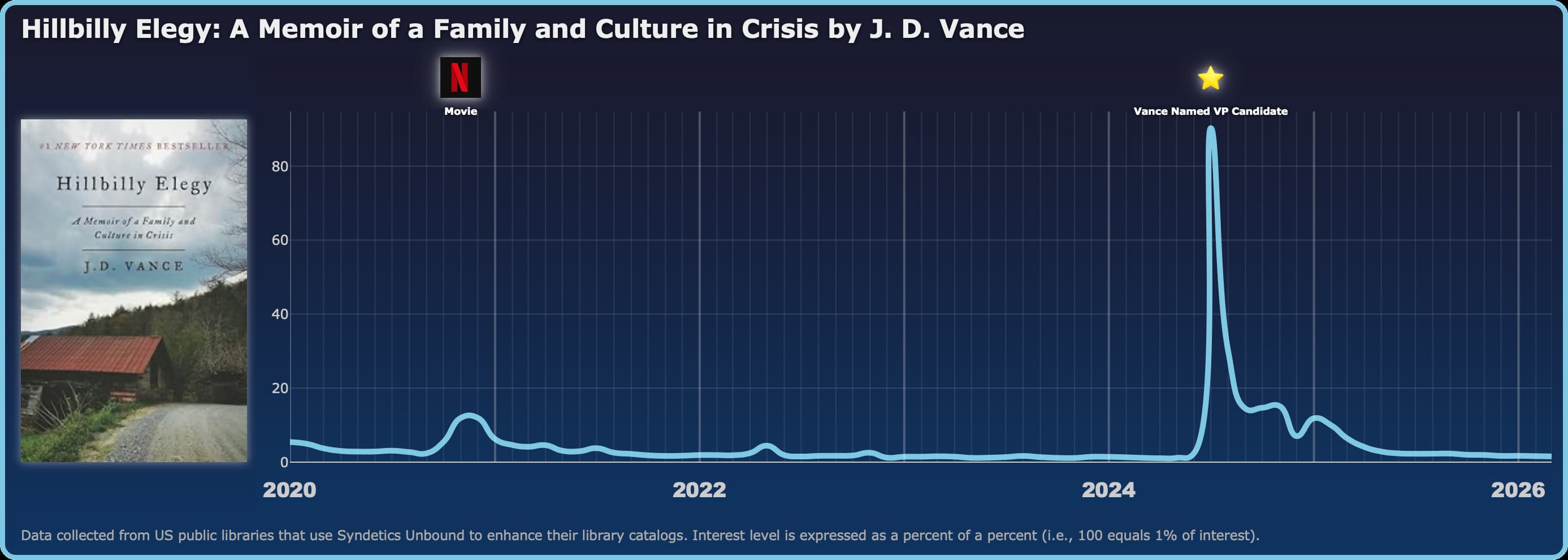
Not every spike comes from Hollywood. Hillbilly Elegy by J.D. Vance was a massive bestseller when it was published in 2016—number one on the New York Times list, three million copies sold—as readers tried to understand the forces behind Trump's rise. The Netflix movie in November 2020 produced a modest bump. But the biggest moment came in July 2024, when Vance was named as the Republican vice presidential candidate. Library interest jumped from near-zero to over 90—dwarfing the movie's impact.
This is a powerful reminder that a spike in interest can come from many directions!
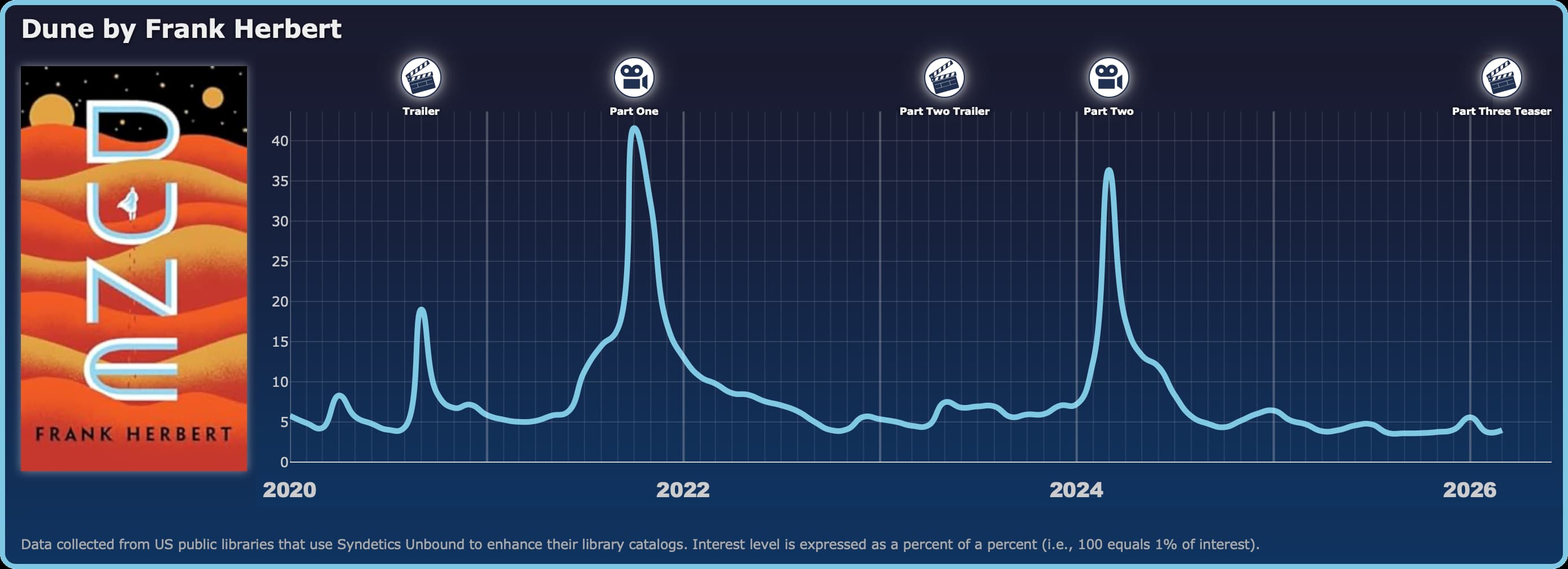
Frank Herbert published Dune in 1965. That's over sixty years ago—before the Moon landing, before the personal computer, before the internet. And yet it's one of the most reliably searched-for titles in US public library catalogs today.
The trajectory chart shows why. Four adaptation events across four years—the first trailer (September 2020), Part One (October 2021), the Part Two trailer (May 2023), and Part Two (March 2024)—are each visible as distinct spikes. So far the Part Three Teaser hasn't created a spike in library interest, but you can be sure that the theatrical release will send readers to the catalog for Dune, Dune Messiah and the rest of the series.
Here's what else you can start planning for:
These trajectories suggest several practical takeaways:
The interest scores in our trajectory charts come from anonymized usage data collected from thousands of public libraries across the United States and around the world that use Syndetics Unbound. The data is anonymized on the day it is received—we never see individual patron activity, only aggregate patterns.
Interest is measured as a share of total catalog interest for a given title, expressed on a scale where 100 equals one percent of all views. Such small changes show up because the underlying dataset is so large, comprising more than five billion data points. Calculating interest as a percentage of all interest removes daily and seasonal variation, so that the spikes you see in the charts reflect genuine shifts in patron interest, not calendar artifacts.
This same dataset powers our monthly Top Titles at Public Libraries posts and our annual roundups like Top Syndetics Unbound Titles of 2025. This post only scratches the surface—with a dataset this rich, there's much more to explore!